IVDR Rule 7: When Is IVD Control Material Class B? (MDCG 2020-16 Rev. 5)
MDCG 2020-16 Rev. 5 clarifies when IVD control material without an assigned value falls under class B, and when another rule applies.
MedNet EC-REP
Author
In September 2026, the Medical Device Coordination Group (MDCG) published Revision 5 of its guidance document MDCG 2020-16 on the classification of in vitro diagnostic medical devices (IVDs) under Regulation (EU) 2017/746 (IVDR).
Only one substantive point changed: the rationale behind Rule 7 in Annex VIII, which governs the classification of control material without an assigned value. Manufacturers of such controls should take a look, because the clarification affects whether a product qualifies as class B or falls under a different rule.
In Brief
- MDCG 2020-16 Rev. 5 (September 2026) changes only the rationale and examples for Rule 7. The rest of the guidance is unchanged.
- Rule 7: control material without a quantitative or qualitative assigned value is classified as class B.
- Key clarification: a value range the manufacturer states in the Instructions for Use (IFU) does not by itself make the control material a product “with an assigned value.” What counts is the target value the laboratory itself sets.
- Controls with a value assigned by the manufacturer, including assay kit validity controls, fall under Implementing Rule 1.6 and take the class of the reagent they belong to.
- Internationally certified reference material and material used for external quality assessment (EQA) schemes are not IVDs at all, under IVDR Article 1(3).
Rule 7 at a Glance
Rule 7 in Annex VIII IVDR is short: control material without a quantitative or qualitative assigned value is class B. This covers material manufacturers intend for use in IVD procedures without giving it a fixed target or reference value.
Laboratories must continuously monitor the validity of their examination results and verify the performance of their equipment. Many use additional, standalone quality control material alongside the control material supplied by the reagent or instrument manufacturer. The IFU must then state that this additional material only monitors the validity of laboratory procedures. It does not replace the controls required to verify the performance of the IVD itself.
The Rev. 5 Clarification: Who Sets the Target Value?
A manufacturer may state a value range in the IFU, for instance information on the presence or concentration range of an analyte in the control material. That statement alone does not make the material a product with an assigned value under the IVDR.
An assigned value is the target value the laboratory itself routinely determines and uses. The manufacturer's range is only guidance. Unless another rule applies, the control material remains class B under Rule 7. That holds even when the IFU includes a value statement.
Distinguishing Implementing Rule 1.6
The picture changes once the manufacturer assigns a quantitative or qualitative value itself. This applies explicitly to validity controls supplied with an assay kit. Such controls do not fall under Rule 7. They are classified under Implementing Rule 1.6 and take the class of the reagent they control for (to illustrate: control material for a class C reagent would itself be class C in that case — this specific example is ours, not one from the guidance).
In practice, this is where manufacturers are most likely to misclassify. The question is not whether a product is a control material. It is who assigns the target value: the manufacturer, or the laboratory.
What Doesn't Count as an IVD: EQA Material and Certified Reference Material
The guidance notes one more exemption that is a relief for many market participants. Under Article 1(3)(c) and (d) IVDR, internationally certified reference material and material used for external quality assessment (EQA) schemes are not IVDs at all. Manufacturers who supply only such material do not need to apply Rule 7 here in the first place.
What This Means in Practice for Manufacturers
For manufacturers of standalone control material, the clarification brings legal certainty. A value statement in the IFU alone does not trigger a higher class. Manufacturers who market control material with a fixed value they assign themselves, for example as part of an assay kit, should check the classification against Implementing Rule 1.6 rather than Rule 7, and document that.
Examples from the Guidance
Rev. 5 lists the following non-exhaustive examples of control material under Rule 7:
- Unassigned control sera
- Control materials used to verify migration in immunochromatographic assays
- Unassigned heterozygous quality control to monitor the analytical performance of nucleic acid extraction, amplification and detection
- Non-assay-specific control plasma for coagulation testing
- Non-assay-specific control serum containing multiple biochemical analytes
- A DNA or RNA probe supplied as a non-assay-specific normal control for in situ hybridisation (ISH)
Summary
Control Material Type | Classification | Legal Basis |
|---|---|---|
Control without an assigned value (manufacturer's statement is guidance only) | Class B | Rule 7 |
Control with a value assigned by the manufacturer (including assay kit validity controls) | Class of the associated reagent | Implementing Rule 1.6 |
Certified reference material / EQA material | Not an IVD | IVDR Art. 1(3)(c), (d) |
FAQ
Does Rev. 5 automatically change the classification of existing control materials?
No. The wording of Rule 7 itself is unchanged; only the rationale and examples were revised. Manufacturers who already classified their material correctly as class B don't need to adjust anything.
Does a value range in the IFU automatically make my control material a product with an assigned value?
No. What matters is the target value the laboratory routinely uses, not the manufacturer's stated range.
What applies to validity controls supplied with an assay kit?
If the manufacturer assigns them a value, they fall under Implementing Rule 1.6 and take the class of the associated reagent, not Rule 7.
Does Rule 7 apply to material used in external quality assessment (EQA) schemes?
No. Under Article 1(3)(d) IVDR, such material is not considered an IVD at all.
Where can I find the original wording?
In the MDCG 2020-16 guidance document (Rev. 5), under Rule 7, which sets out the rationale and non-exhaustive examples.
Conclusion
Rule 7 stays what it was: class B for control material without an assigned value. Rev. 5 only clarifies when a value counts as assigned, and draws a clear line to Implementing Rule 1.6.
Not sure how to classify your control material?
Our team reviews the classification of your IVDs under Annex VIII IVDR and guides you through the right conformity assessment route.
Related Articles
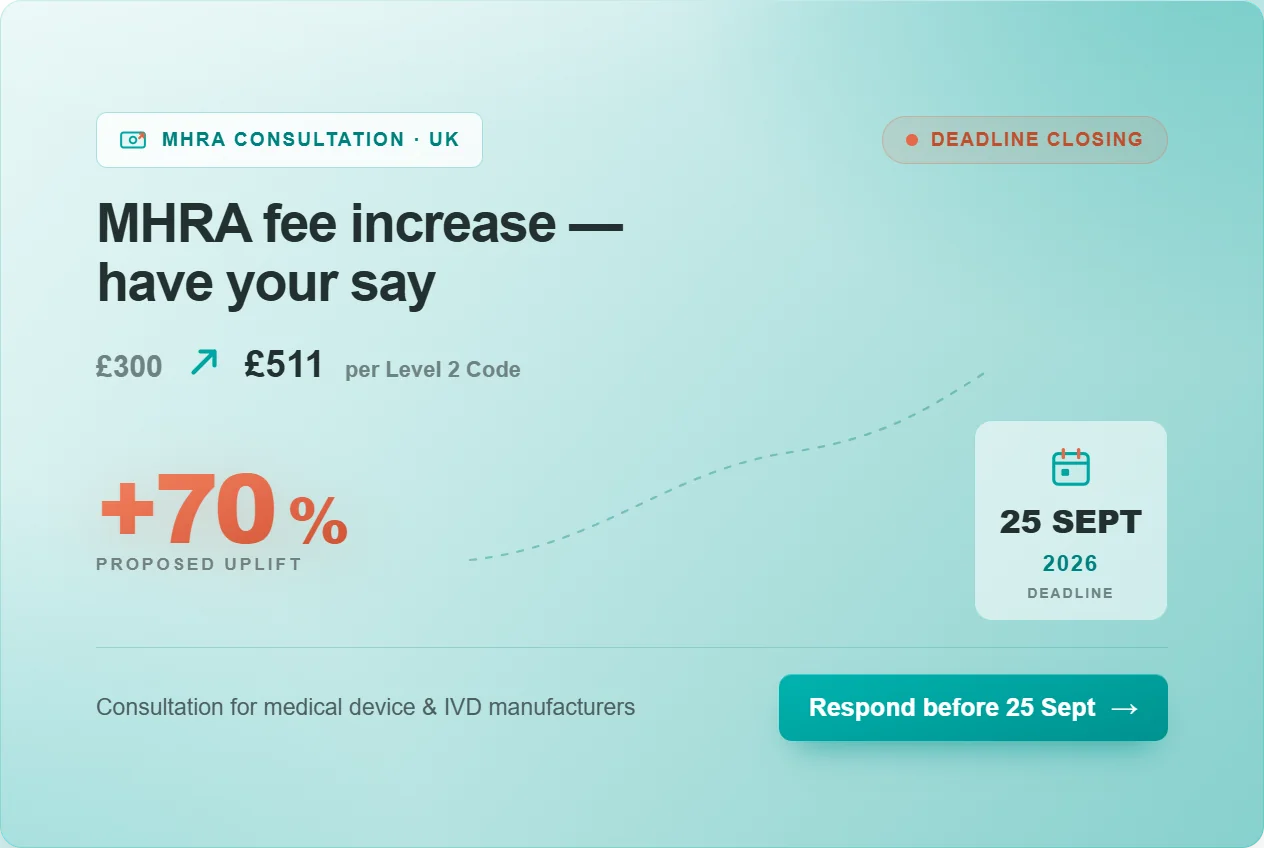
MHRA Consultation 2026: The Fee Increases Coming for Medical Device Manufacturers in 2027
The MHRA has opened a consultation on fee increases from April 2027 — including a proposed 70 % rise in the post-market surveillance fee. Manufacturers have until 25 September to respond.

New EU Study: Where Manufacturers and Authorised Representatives Really Stand on MDR and IVDR
New EU study finds 48% of manufacturers have withdrawn devices from the market. Key MDR/IVDR and AR findings for 2026. Read the numbers now.

Well-Established Technologies Under the MDR: EU Commission Expands Exemption List
The EU Commission has expanded the WET list under the MDR, easing requirements for certain class II and class III devices.
Stay Updated
Get the latest regulatory updates and industry insights delivered to your inbox.
Subscribe to Updates